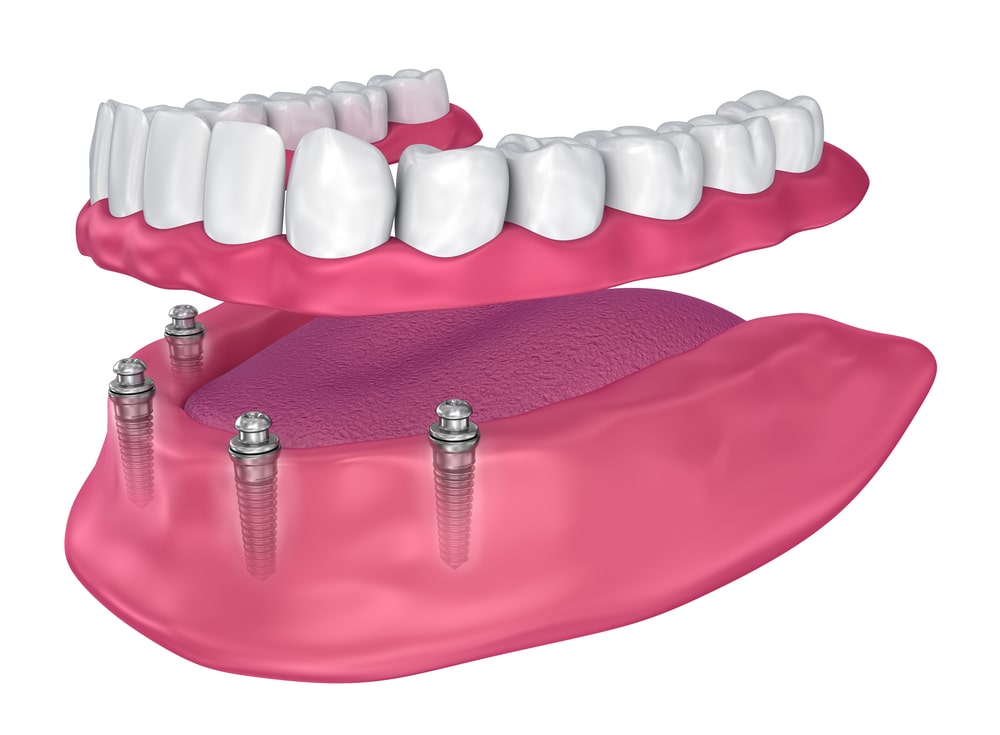
People with missing teeth can benefit from effective tooth replacement options thanks to implantology. Dental implants make it possible to create strong anchors that support different types of restorations. Among these solutions is the dental prosthesis on implants.
Learn more about the advantages of a dental prosthesis on implants in the article below.
What Are Dental Implants Used For?
Dental implants are small titanium screws. During a surgical procedure performed by your dentist at the clinic, the implants are inserted directly into the jawbone through a small incision in the gum. During the healing process, the implant fuses with the jawbone as new bone cells naturally form around it.
A dental implant replaces the root of a missing tooth, allowing a dental restoration such as a crown to be placed on top. Several implants can also be inserted to replace multiple missing teeth or even an entire dentition. This is where a dental prosthesis on implants becomes particularly relevant.
Why Choose a Dental Prosthesis on Implants?
A removable dental prosthesis on implants is most often used to replace all the teeth of the lower jaw. Depending on the clinical situation, two to four implants are placed and allowed to heal. Once healing is complete, a dental prosthesis is fabricated to perfectly match the patient’s anatomy.
The implants are fitted with small metal attachments that securely hold the prosthesis in place. Compared to a traditional denture, which relies mainly on suction against the gums, a prosthesis on implants offers many advantages.
Excellent Stability
Dental implants provide excellent stability to the prosthesis. They help eliminate movement and clicking noises that can occur with traditional dentures. This increased stability improves comfort, reduces irritation of the oral tissues, and often enhances self-confidence.
Few Food Restrictions
Because the prosthesis is firmly anchored by implants, patients can eat almost as if they had natural teeth. Chewing efficiency is improved, allowing for a more varied diet, including firmer foods. Better chewing also contributes to improved digestion.
Prevention of Bone Loss and Muscle Atrophy
When tooth roots are missing, stimulation of the jawbone decreases, leading to bone loss over time. This results in a reduction in bone height and thickness. Traditional dentures do not prevent this process because they do not replace tooth roots.
Dental implants help slow bone loss by stimulating the jawbone. In addition, wearing a dental prosthesis helps support facial muscles and prevents muscle atrophy, which can occur in cases of complete tooth loss.
Easy Hygiene
A removable prosthesis on implants can be taken out for cleaning, making daily oral hygiene simple and effective. Brushing and maintaining good oral health remain easy, even with implants.
If you believe that a dental prosthesis on implants could be a good solution for you, we invite you to discuss it with our team. Request a consultation with a dentist at the Centre Dentaire de Haute Technologie du Québec to explore your options.