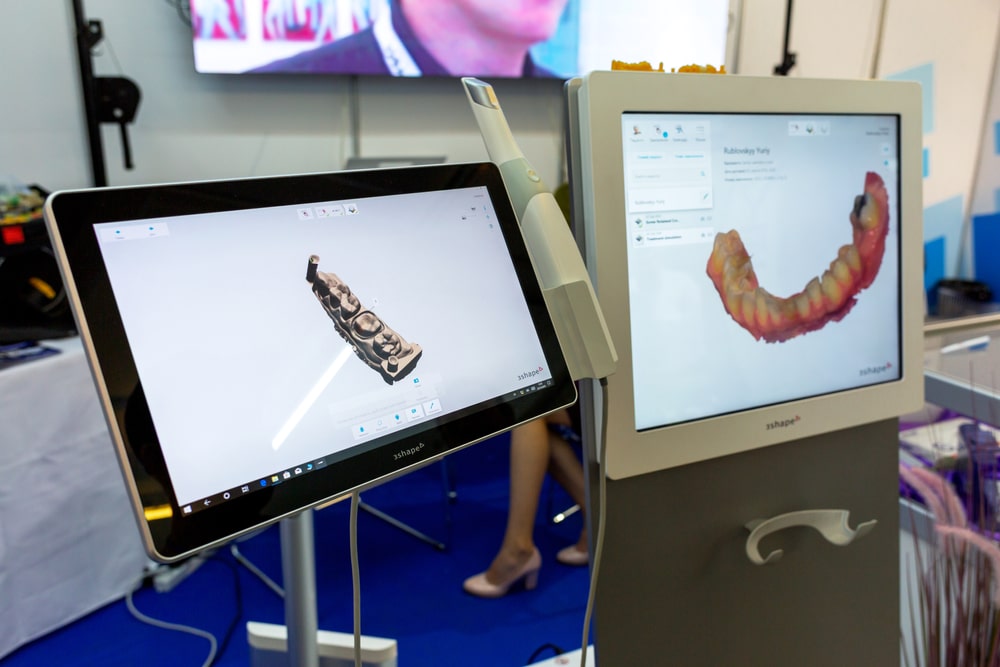
Our clinic is committed to using advanced dental technologies to deliver effective, comfortable, and modern treatments. Among the technologies used by our dentists is the CEREC system. It allows us to design, manufacture, and place high-quality dental restorations, all in a single appointment. Learn more about the benefits of this technology.
Crowns, Inlays, and Ceramic Veneers
Our clinic has been using CEREC technology since 1997. We were among the pioneers in adopting this innovative approach to designing ceramic dental restorations. Over the years, and still today, we have perfected our expertise and acquired increasingly modern technologies.
CEREC stands for Chairside Economical Restoration of Esthetic Ceramic. This technology makes it possible to complete all steps involved in designing and manufacturing a ceramic restoration directly in the clinic. All of this is done in a single visit. We will outline these steps below.
CEREC can be used to fabricate three main types of dental restorations:
Dental Crown
A crown is a hollow prosthetic tooth placed over a damaged or worn tooth. A crown may be recommended after a dental fracture or root canal treatment to strengthen and protect a weakened tooth. A crown can also be placed on a dental implant to replace a missing tooth.
Inlay/Onlay
An inlay or onlay works similarly to a filling used to treat and repair a tooth, particularly in cases of decay. However, it is larger and designed to replace part of the tooth’s natural structure.
Dental Veneers
These thin shells are placed on the front surface of incisors and canines to enhance the appearance of visible teeth. With CEREC, we can create high-quality, highly aesthetic ceramic veneers.
The CEREC Design and Manufacturing Process
Several steps are required to design and place a restoration using CEREC technology. However, all of these steps are completed during a single appointment, assisted by advanced digital systems.
Once the initial consultation is completed and CEREC is confirmed as a suitable option, the following simple steps take place:
1. Local Anesthesia and Tooth Preparation
Local anesthesia is administered, and the tooth is prepared. This may involve removing damaged portions or, in the case of veneers, removing a thin layer of enamel to create the space needed for the restoration.
2. Digital Impressions
Using a digital scanner, impressions of the tooth and surrounding teeth are captured. This is done simply by gliding the scanner over the teeth. There is no discomfort and no inconvenience, and the process takes only a few minutes.
3. Restoration Design
The digital impressions are used to design the restoration. The data is transferred to specialized software that creates a 3D model of the restoration.
4. Milling by the Robotic Unit
The 3D model is sent to the milling unit, which sculpts the restoration from a high-quality ceramic block selected to match the patient’s natural tooth color. Milling is completed within minutes.
5. Placement and Adjustments
The restoration is then placed and cemented onto the tooth. If necessary, the dentist makes small adjustments to ensure optimal comfort and aesthetics.
A Faster and More Convenient Alternative
Compared with traditional methods, which require multiple appointments and the use of temporary restorations, CEREC offers a faster, more efficient and more comfortable solution.