Cancer is an illness that frightens everyone. Unfortunately, our oral health is not spared from it. In fact, oral cancer is one form of the disease. Since prevention begins with awareness, our team has prepared this article. We want to educate you about the risk factors, the signs and symptoms of the disease, as well as the role of your dentist and your hygienist in screening for oral cancer.
Oral cancer: facts and figures
Abnormal cells can form on all oral mucous membranes, the soft tissues of the mouth such as the tongue, inner cheeks, and palate. This is how oral cancer begins, sometimes referred to as cancer of the oral cavity or oral cancer. The Canadian Cancer Society estimated that in 2020, 5,400 Canadians would receive a diagnosis of oral cancer and 1,500 people would die from it.
Age is an important risk factor for oral cancer, as the disease is most often diagnosed in people aged 45 and older. However, age is a factor we cannot control, unlike others. Tobacco use and heavy alcohol consumption are the two most significant risk factors for developing this type of cancer. When combined, these risks are multiplied.
Other risk factors include poor oral hygiene, human papillomavirus (HPV) infection, family history, and sun exposure to the lips. Visit the CCS website to learn more about the risk factors for oral cancer.
Signs and symptoms
Oral cancer is sneaky. It is often asymptomatic in its early stages, meaning it progresses without noticeable changes to the oral tissues. However, as it progresses, it can be detected through the following signs and symptoms:
- A lesion on the lips or oral mucosa that does not heal after two weeks
- Red or white patches that persist beyond two weeks
- Pain and difficulty during eating, especially chewing and swallowing
- Oral bleeding not caused by trauma
- The formation of one or more small masses in the jaws, neck, or inside the mouth
- Persistent changes in the voice
VELscope: for early oral cancer screening
As mentioned, these signs and symptoms often appear once the disease has reached a more advanced stage. In its early and asymptomatic stage, oral cancer can only be detected by the trained eye of an oral health professional, your dentist or hygienist. They are trained and qualified to screen for oral cancer, although only the dentist can make a diagnosis. Did you know that during your routine visits, we take time to examine your oral mucosa for signs of oral cancer?
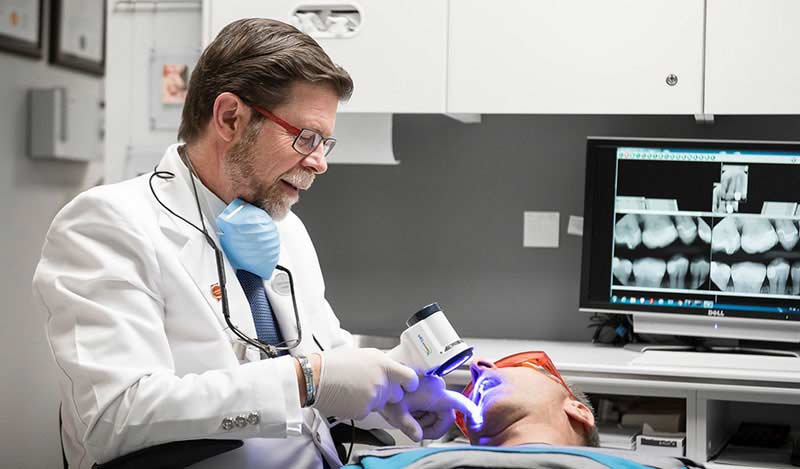
At the Centre Dentaire de Haute Technologie du Québec, we also use VELscope technology, which is fast, safe, and painless. Using a special light, VELscope helps detect the presence of abnormal cells inside the mouth. This allows us to identify cancerous or precancerous conditions early and refer the patient to the appropriate treatment. As with many types of cancer, when oral cancer is detected early, the patient’s chances of survival improve significantly.
To help prevent oral cancer, avoid tobacco products, limit your alcohol consumption, and maintain proper oral hygiene. Finally, remember that routine visits and dental exams performed by your dentist and hygienist are essential for detecting and diagnosing oral cancer. Do not neglect them, they help protect you from the disease!