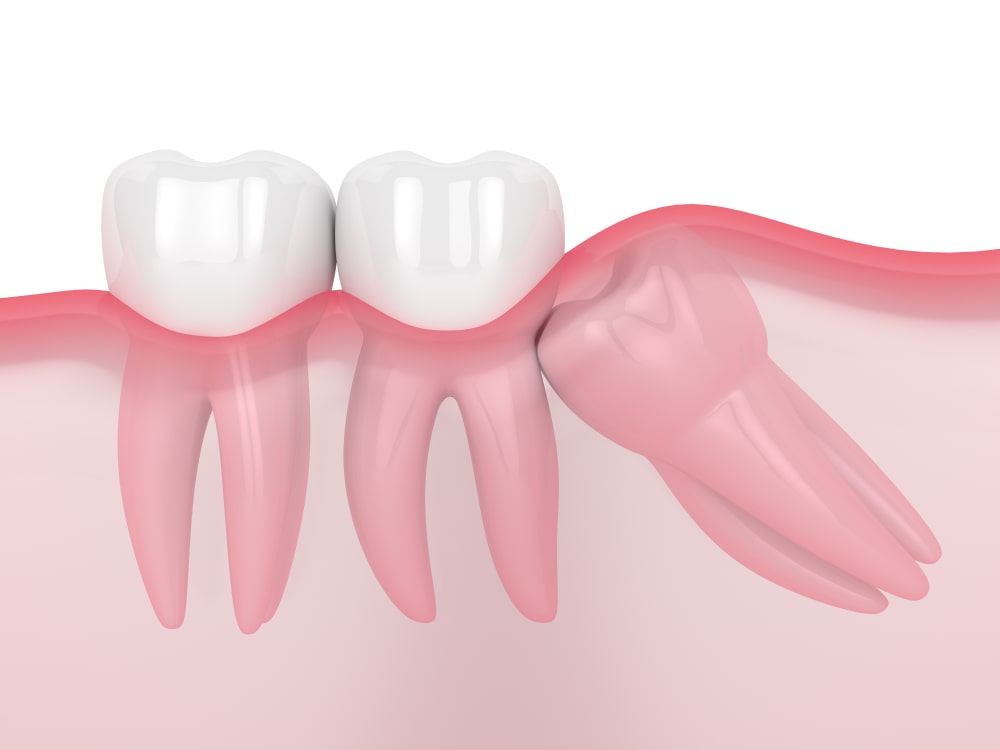
Wisdom teeth are the third molars that emerge later in life. In most cases, they erupt toward the end of adolescence or the beginning of adulthood. In this article, we discuss why these teeth are often problematic, the risks associated with them, and the factors to consider when determining whether they need to be extracted.
Irregular Eruption
We inherit wisdom teeth from our ancestors, the cavemen. However, human jaws have evolved and often do not have enough space for these teeth to grow normally and align properly. This explains why their eruption is often irregular.
Not only can wisdom teeth erupt in the wrong position due to lack of space, but they can also remain partially or completely beneath the gum. These are referred to as partially impacted or fully impacted teeth. In both cases, they can cause distinct problems.
Partially impacted teeth create an entry point for oral bacteria, which can get under the gum and cause infections. Fully impacted teeth may deviate from their normal axis and damage the roots of neighboring teeth. These potential complications should not be ignored.
Examples of Wisdom Teeth Complications
- Root cavities: Partially impacted wisdom teeth increase the risk of cavities forming at the roots. Bacteria can penetrate beneath the gum, making root cavities harder to treat.
- Pericoronitis: An infection of the tissue surrounding the wisdom tooth, often occurring when a portion of the gum partially covers the tooth or a small gap exists between the tooth and gum. Food debris and bacteria can get trapped, increasing the risk of infection.
- Damage to adjacent teeth: Impacted or partially impacted teeth that deviate from their eruption path can damage neighboring teeth and their roots. In severe cases, the affected teeth may lose viability.
- Cysts and tumors: Problematic wisdom teeth can create an environment conducive to the development of cysts or tumors, whether benign or malignant.
How to Determine if Wisdom Teeth Should Be Extracted
Wisdom teeth can be evaluated during adolescence, even if they have not yet erupted. Radiographs allow observation of the teeth at this stage. Since the jaw is still growing and the roots are more flexible, extraction is generally easier if it is deemed necessary.
Factors considered when determining the need for extraction include: